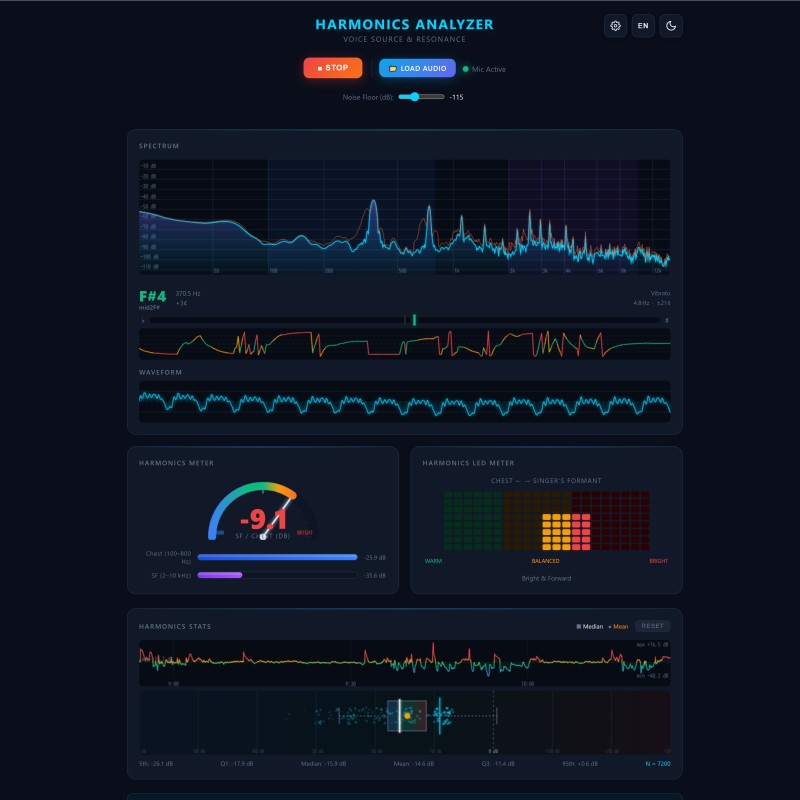
How it works: Spectral energy is integrated across two bands: the Chest zone (100–800 Hz) covering the fundamental and lower formants (F1/F2), and the Resonance zone (2–10 kHz) where the Singer's Formant around 3 kHz and upper harmonics cluster (referred to as SF). The meter shows SF / Chest (dB) = 10 · log₁₀(SF power / Chest power). −15 dB is the balanced center; values above −10 dB indicate brilliance / Singer's Formant-dominant tone; values below −20 dB indicate warm / chest-dominant tone. The Noise Floor (dB) setting acts as a noise gate — bins below the threshold are excluded from both band calculations. Blue on the spectrogram marks the Chest zone; purple marks the Resonance zone. The box plot shows the distribution of SF / Chest (dB) values over the session; it freezes as a final result when analysis stops.
Support with XRPrshhisEHRFPr5MXsB4aRRmNTNHsFoPgJZpXaman を起動してから、アプリ内の QR スキャン機能でお読みください
What is Singer's Formant?
The Singer's Formant (SF) is a concentration of acoustic energy between 2 and 4 kHz, produced when a trained singer clusters their third, fourth, and fifth vocal formants. It allows the voice to cut through an orchestra without amplification. This analyzer measures the ratio of SF energy (2–10 kHz) to chest energy (100–800 Hz) in real time, giving a precise dB readout of how much resonance the voice carries relative to its fundamental strength.
How to use this analyzer
Click Start Microphone and sing a sustained note. The Harmonics Meter shows SF / Chest in dB — values near 0 dB indicate balanced tone; negative values indicate warm, chest-dominant voice; positive values indicate a bright, forward sound with strong Singer's Formant. The session box plot accumulates readings over time, giving a statistical picture of your typical resonance balance across a full vocal session.
Real-time pitch and vibrato detection
The analyzer uses a Harmonic Product Spectrum algorithm to detect the fundamental frequency of your voice from 80 Hz to 1500 Hz — covering bass through soprano range. Detected pitch is shown as a note name with octave (e.g., A4 = 440 Hz), a live tuner bar for intonation feedback, and a scrolling pitch history graph showing the last ten seconds of intonation. Vibrato rate (Hz) and depth (cents) are measured automatically when the voice sustains a pitch with sufficient oscillation.
Frequency bands explained
The Chest zone (100–800 Hz) covers the fundamental frequency and the first two formants (F1/F2), which determine vowel quality and the basic fullness of the voice. The Singer's Formant zone (2–10 kHz) captures the upper formant cluster (F3–F5) responsible for vocal brilliance and projection. The Floor (dB) setting acts as a noise gate — frequency bins below the threshold are excluded from both band calculations to prevent room noise from skewing the ratio.