Have you ever seen
your voice's harmonics?
When someone says "your voice is rich with harmonics," it feels too vague to grasp—or so it seems. Harmonics can be seen. Measured in numbers. And trained.
Try VOXTRUM →Harmonics aren't mystical.
You can see them with a spectrometer.
"Add more harmonics," "resonate more," "open it up"—these are phrases you hear constantly in voice training. But don't they sound a bit like mystical advice? Harmonics are a physical phenomenon.
How much harmonic content is in your voice can be measured with a spectrometer (frequency analyzer). It shows up as a visible graph. It appears as numbers. It's acoustics, not mysticism.
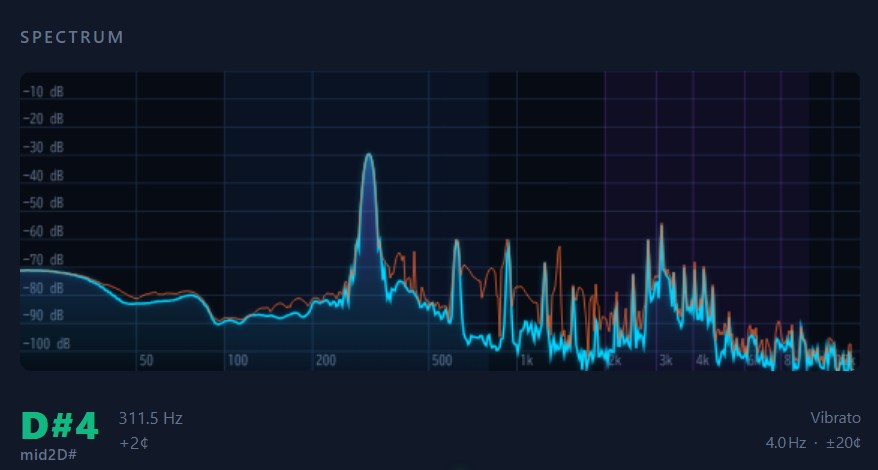
A spectrometer shows
the power at each frequency.
A spectrometer graph displays frequency (pitch) on the horizontal axis and power (intensity) on the vertical axis.
When you produce a sound, peaks appear on the graph. The taller the peak, the stronger that frequency. Your voice contains not just the fundamental tone, but also peaks at integer multiples of that frequency—the harmonics. A voice rich in harmonics shows many tall, distinct peaks across the graph.
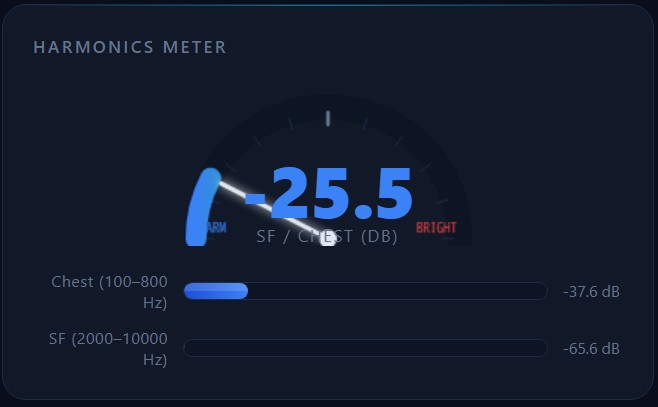
Harmonics Meter:
Higher number = richer resonance.
VOXTRUM's Harmonics Meter shows how much harmonic energy is present relative to the fundamental—expressed as a single number. No need to read a complex spectrum graph. One number tells you "how resonant is my voice right now."
A voice with abundant harmonics tends to carry farther and leave a stronger impression, even at the same volume. The "penetrating," "colorful" quality that professional singers and voice actors possess is partly captured by this harmonic richness.
From feeling-based training
to quantitative training.
"Resonate more," "project forward," "go deeper"—voice training instructions are full of intuitive, feeling-based language. That's not necessarily wrong, but without metrics, it's hard to track progress.
With VOXTRUM, you can make comparisons like these:
When you say "ah" versus "oh," which gives a higher reading on the Harmonics Meter? Which mouth shape, which way of using your throat pushes the number up? What you grasp intuitively can now be confirmed with data.
Record progress, compare results, reproduce success. Combining intuition with data makes voice training more reproducible and reliable.
Load your karaoke recording
and find out why you were in top form.
Do you have a recording where you sang really well at karaoke? VOXTRUM has a feature to load audio files. Analyze a past performance to discover exactly why you were in such great shape that day.
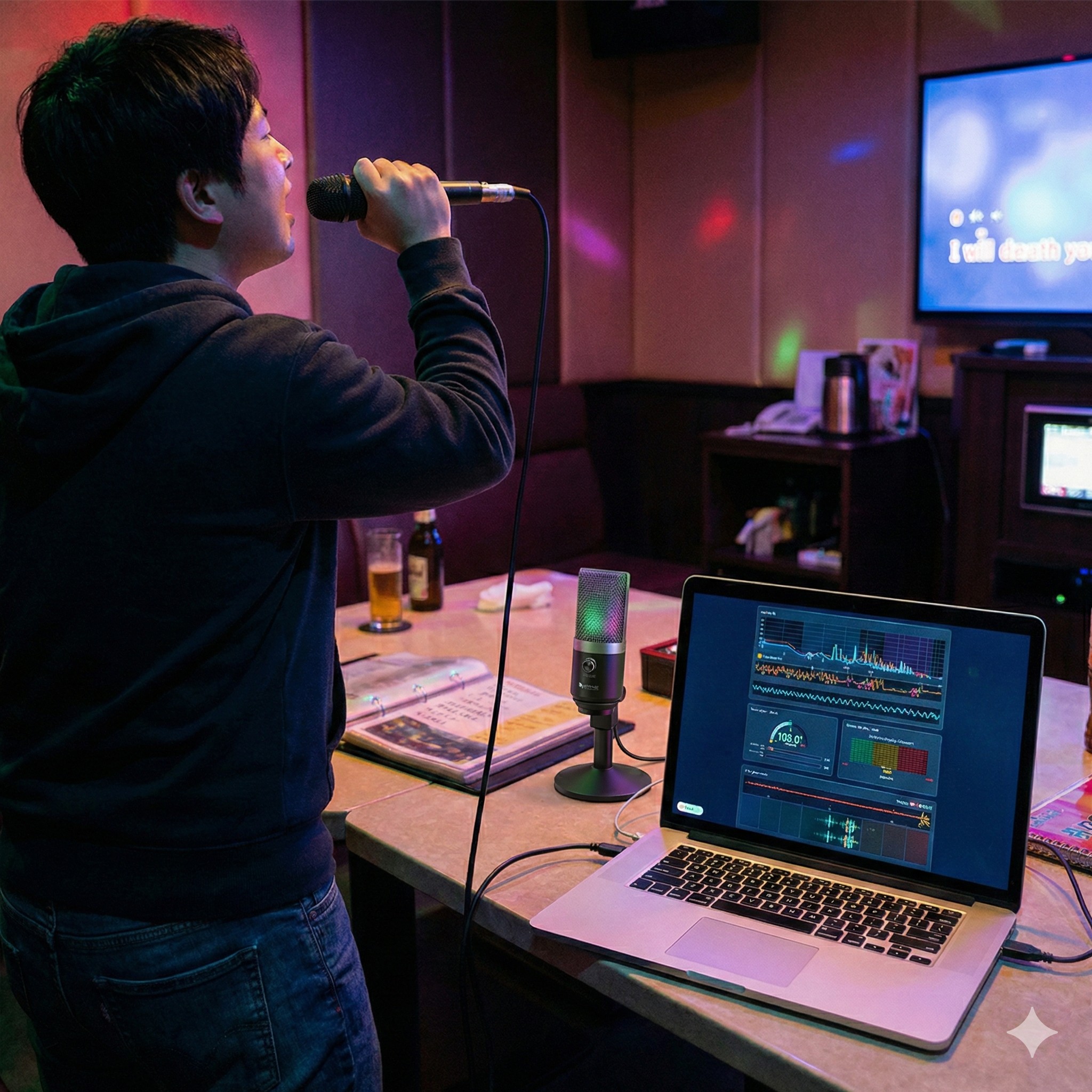
You can also record a singer you admire and load their voice for analysis. Visualizing their spectrum shows you which frequencies dominate their sound. Compare it side by side with your own voice and close the gap, step by step.
With the pitch monitor too,
it's perfect for singing training.
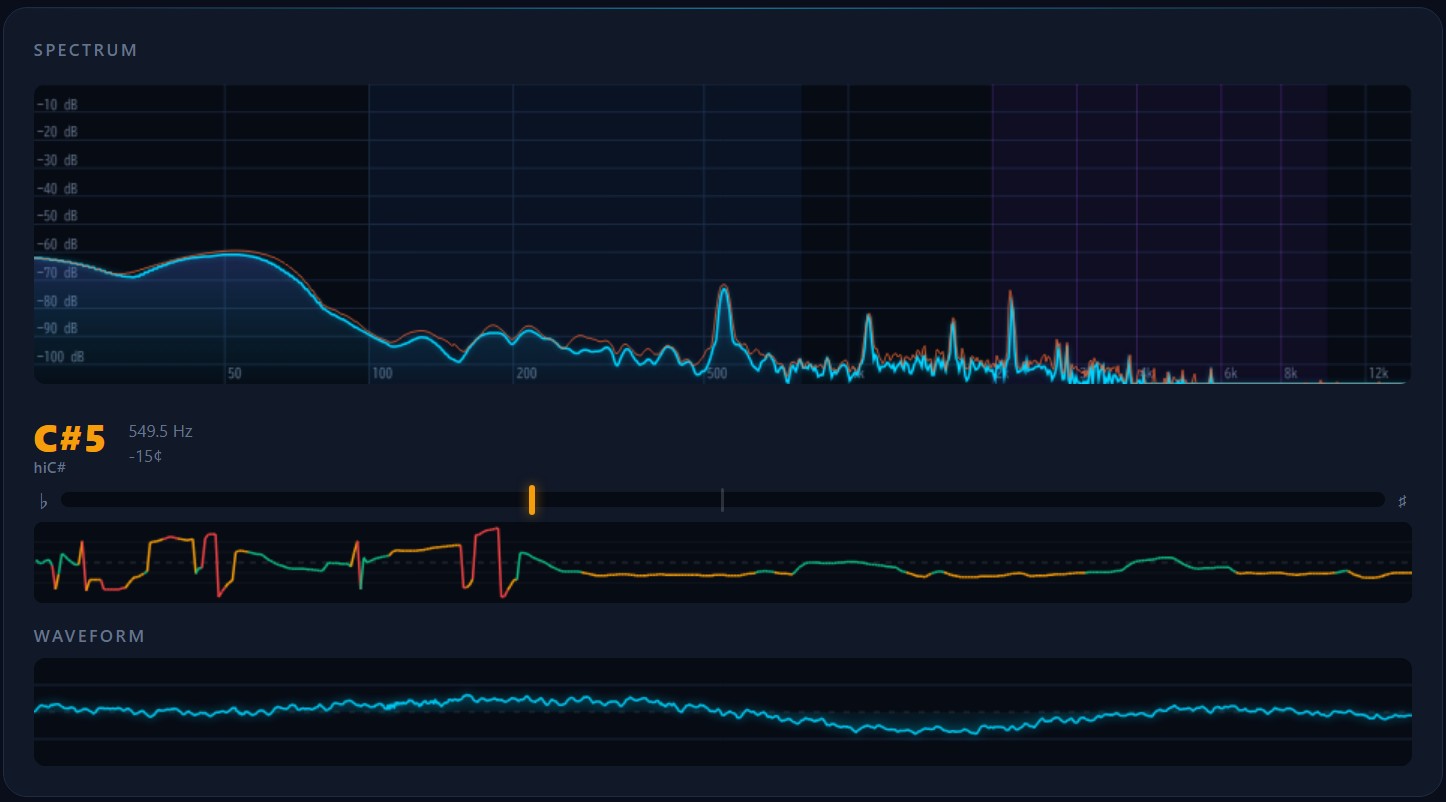
Beyond harmonics, you can also check pitch accuracy—essential for singing. VOXTRUM includes a pitch monitor that displays the note you're singing in real time.
Use it as a tuner, or practice while watching pitch stability to identify your vibrato range and the register where you're most consistent. Checking harmonics and pitch simultaneously is uniquely possible with VOXTRUM.
First, try visualizing
your own voice.
Having more harmonics isn't everything. But if you've ever wondered "what are harmonics, exactly?"— try looking at your voice as a graph. Seeing it in numbers will give you new insights. Free to use in your browser.